

Dante Moore Carted Off After Brutal Hit in Oregon-USC Game

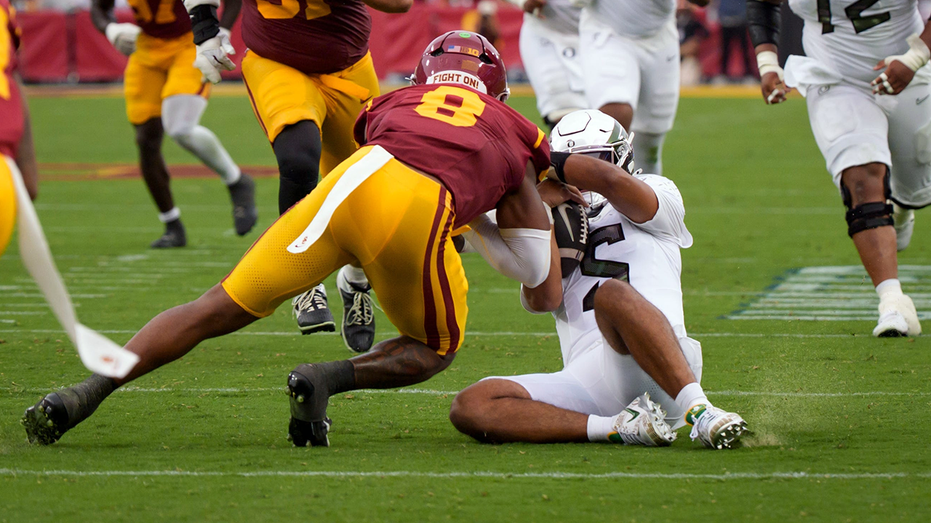
Oregon quarterback Dante Moore left the field on a cart after taking a violent hit to the head during the Ducks’ matchup with USC, a moment that immediately shifted the focus from the scoreboard to his health. The play unfolded in the middle of a high-intensity stretch, with Moore absorbing contact that appeared to snap his head back before he went down. Medical staff rushed onto the field, and after several tense minutes, he was placed on the cart and taken off as teammates and fans watched in silence.
The scene quickly raised concern because head injuries remain one of the most serious issues in college football. Even before any official diagnosis, the visible nature of the hit and the extended attention from trainers suggested that Oregon’s medical staff was taking every possible precaution. In situations like this, that response is standard and necessary, especially when a quarterback shows signs that require immediate evaluation for a possible concussion or related trauma.
Moore’s exit also created an immediate football impact for Oregon. Losing a starting quarterback in a major game against a conference rival changes everything, from play-calling to pace to overall confidence on offense. Backup preparation becomes critical in those moments, and the Ducks were forced to adjust quickly while also managing the emotional effect of seeing their quarterback leave in such alarming fashion.
Why the hit drew so much attention
The collision stood out not just because of its force, but because contact to the head area is under heavier scrutiny than ever. Officials, coaches, and medical personnel are expected to respond aggressively when a player takes a blow that appears dangerous, particularly if there is any sign of disorientation or instability. Whether the play results in a penalty or later review, the larger issue is always the player’s condition and the timeline for a safe recovery.
For Oregon, the next steps will depend entirely on medical evaluation. Teams typically avoid offering immediate specifics until testing is complete, and that can leave a gap filled by speculation. What is clear is that Moore will have to go through the proper protocol before any return is considered, and that process is designed to prioritize long-term health over short-term competitive urgency.
USC, meanwhile, found itself on the other side of a moment no team wants to see. Regardless of rivalry or game stakes, injuries of this nature tend to bring a visible pause across the field. Players understand how quickly a routine snap can turn into a frightening scene, and the reaction from both sidelines reflected that reality.
What happens next for Oregon
In the coming days, attention will center on Moore’s status, Oregon’s quarterback depth, and whether the Ducks must prepare for an extended absence. If he is diagnosed with a concussion, his availability would depend on symptom resolution and clearance through established medical steps. That uncertainty can affect not only one game plan, but the broader rhythm of an offense that relies on timing, communication, and trust under pressure.
Beyond the tactical consequences, the moment serves as another reminder of how college football continues to wrestle with player safety. Big hits may remain part of the sport, but the response to them has changed, and rightly so. For now, Oregon’s biggest concern is simple: that Dante Moore recovers fully, and that any decision about his return is made with caution rather than urgency.
Install in seconds and keep earning from your phone.
Frequently Asked Questions
What's Your Reaction?
 Like
0
Like
0
 Dislike
0
Dislike
0
 Love
0
Love
0
 Funny
0
Funny
0
 Wow
0
Wow
0
 Sad
0
Sad
0
 Angry
0
Angry
0






Comments (0)