

Angel Reese DPOY win raises questions about WNBA media hype

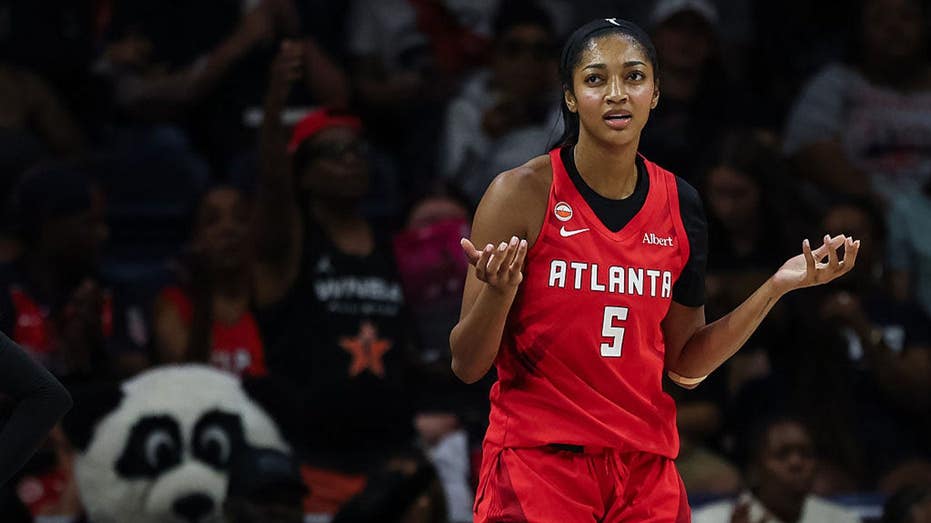
Angel Reese had a strong enough season to belong in the WNBA Defensive Player of the Year discussion. Her rebounding, activity level and knack for creating turnovers gave voters a real case to consider. What stands out is not that she won the award, but how decisively she won it.
Reese received 46 of 74 votes in the award announced Thursday. Gabby Williams finished second with 20, while A’ja Wilson received only four. That gap is hard to ignore. Reese earned more than twice as many votes as Williams and more than 11 times as many as Wilson, even though both players had serious arguments of their own.
The result feeds a broader concern about how Reese is covered. Too often, the conversation around her seems to move quickly from very good to unquestionably elite. When the same media members who shape that conversation also vote on the award, the outcome can look like a form of self-confirmation: the player is called elite, then handed the trophy, then the trophy is used as proof.
Atlanta had another excellent season, finishing 30-14 and ranking third in defensive rating at 103.5 points allowed per 100 possessions. That is impressive, but it also needs context. The Dream were 30-14 the previous season as well, and in 2025 they ranked second in defensive rating, allowing just 98.9 points per 100 possessions. Atlanta already had an elite defense before Reese arrived, and the team was slightly worse by that measure this year.
That does not mean Reese hurt the defense. Comparing one season to another is never that simple. Rosters, schedules and opponents all change. Still, if her arrival is framed as a dramatic defensive transformation, the team results do not fully support that claim.
Reese’s case is not empty. She helped Atlanta hold opponents to a league-low 9.5 second-chance points per game, averaged 1.8 steals and led the league in defensive win shares. Those are meaningful achievements. But Wilson still offers a wider defensive range. She protects the rim, switches onto guards and can survive possessions far from the paint in ways few bigs can.
That versatility showed in August against Indiana, when Wilson defended Caitlin Clark late in overtime and forced the turnover that led to Chelsea Gray’s winning 3-pointer. Becky Hammon said afterward, “I’ll take that matchup … any day.” That kind of assignment is part of what separates Wilson defensively.
Wilson also led the league in blocks for a fifth straight season at 1.9 per game. Reese averaged 0.7. Wilson averaged 7.5 defensive rebounds per game to Reese’s 7.3, while adding 1.4 steals. Reese’s overall rebounding totals draw attention, but 206 of her 521 rebounds came on offense. Those extra possessions matter, yet they are not defensive stops and should not carry the same weight in this award debate.
Williams also had a strong case. She regularly handled the toughest perimeter assignment for Golden State’s top-ranked defense, and the league’s own awards preview cited Synergy tracking that placed her first in points allowed per possession across tracked play types.
Much of the pro-Reese argument leaned on on/off numbers, but even those figures varied widely depending on the source: 15.5 points in one case, 13 in another and 7.9 in Atlanta’s own announcement. That inconsistency matters, especially because on/off stats reflect five-player units, not one defender in isolation. Similar logic creates problems elsewhere too. One database showed Jackie Young having a bigger defensive on/off impact than Wilson for Las Vegas, which should immediately invite caution.
Reese deserved real consideration. She played winning defense and had a season worthy of recognition. But a 46-20-4 vote split over Williams and Wilson looks less like a settled defensive hierarchy and more like a media group eager to validate a story it already wanted to tell.
Install in seconds and keep earning from your phone.
Frequently Asked Questions
What's Your Reaction?
 Like
0
Like
0
 Dislike
0
Dislike
0
 Love
0
Love
0
 Funny
0
Funny
0
 Wow
0
Wow
0
 Sad
0
Sad
0
 Angry
0
Angry
0














Comments (0)