

Ancient 'rusty treasure' emerges from river with enough iron to forge 500 swords

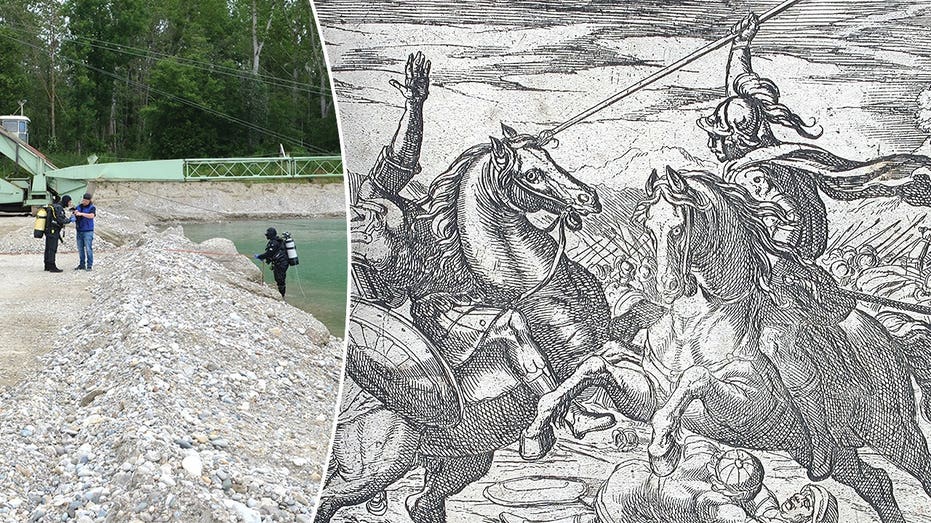
Archaeologists have identified Europe's largest known collection of Iron Age iron bars in Austria — raising the possibility that the valuable cargo was lost in a shipwreck on the Danube River more than 2,000 years ago.
Workers recovered at least 500 bars, making the collection the largest known Iron Age find of its kind in Europe. The "rusty treasure," as researchers called it in a press release, would have been extremely valuable during the Iron Age, when iron production and trade were expanding across Europe.
"Fortunately, the gravel workers [who found the iron bars] reported this find to the Monuments Authority and did not sell them to a scrap dealer," Peter Trebsche, a professor at the University of Innsbruck in Austria, told Fox News Digital.
2,000-YEAR-OLD TREASURE DISCOVERED BENEATH FORMER SPORTS FIELD, BREAKING REGIONAL RECORD
The iron bars — which weigh more than a metric ton in total — could have been used to forge roughly 500 swords weighing between 3.3 and 4.4 pounds each, according to the researchers.
The research was published earlier this fall by archaeologist Trebsche as well as archaeologist Marion Berranger in the journal Antiquity.
The iron bars were originally discovered in 2019 during gravel extraction work in Deinham, Austria.
Researchers used radiocarbon dating to determine the age of the iron bars, which likely date to the third or second century B.C.
MYSTERY DEEPENS AFTER 2,700-YEAR-OLD BRONZE SWORD EMERGES STANDING UPRIGHT
While its intended destination remains unknown, researchers believe the iron may have been forged in Bavaria, Germany, before being transported along the Danube River.
The discovery sheds new light on the scale of ancient iron production, which has been difficult to measure because iron objects are often overlooked or difficult to date the researchers said.
"Therefore, the discovery of numerous double-pointed iron objects during gravel extraction along the River Danube provided a unique opportunity to investigate large-scale prehistoric iron production and trade," the press release said.
In a statement, Trebsche called the discovery "nothing short of a minor miracle."
DIVERS UNCOVER MYSTERIOUS SHIPWRECK LOADED WITH ANCIENT CARGO LOST FOR 2,400 YEARS
He added, "I am sincerely grateful to the finders that [the workers] decided to donate this extraordinary trove to a state museum collection."
Trebsche told Fox News Digital the iron bars were found during gravel extraction work in an old, silt-filled channel of the Danube River.
He said a shipwreck is the most plausible explanation for how the bars ended up in the river, although no remains of a vessel were found.
CLICK HERE TO SIGN UP FOR OUR LIFESTYLE NEWSLETTER
"No parts of the ship were recovered, because this section of the Danube poses some dangers to navigation like stone balls and sand banks," Trebsche noted.
"In support of this interpretation is also the fact that none of the finds shows signs of intentional destruction, which would be indicative of a ritual offering during the Late Iron Age."
He also said the 500-sword figure is only an estimate, as the iron could have been used to make tools or jewelry instead of weapons.
"The amount of iron from Deinham is about ten times larger than the largest iron hoard finds of that period," he said.
CLICK HERE FOR MORE LIFESTYLE NEWS
Trebsche said the most surprising aspect of the discovery was the sheer quantity of iron being transported at once — and the fact that so much was available for a single trade transaction during the Late Iron Age.
TEST YOURSELF WITH OUR LATEST LIFESTYLE QUIZ
"This finding demonstrates the increased capacities of iron production that were reached in the 3rd/2nd century BC in the Danube region," he said.
A number of other Iron Age discoveries have been announced across Europe over the past year.
Earlier this year, archaeologists uncovered a 2,000-year-old temple in Denmark at a major Iron Age settlement that once served as a regional center of power and wealth.
At around the same time, researchers announced the discovery of rare four-wheeled wagon remains among 950 Iron Age metal objects unearthed in northern England, marking the first potential evidence of such vehicles in Britain.

Works on Android, iPhone, Windows and Mac. No Play Store, installs in 2 seconds.
What's Your Reaction?
 Like 0
 Dislike 0
 Love 0
 Funny 0
 Wow 0
 Sad 0
 Angry 0














Comments (0)