

Aces Fans Push Baseless Racism Claims at Fever Supporters

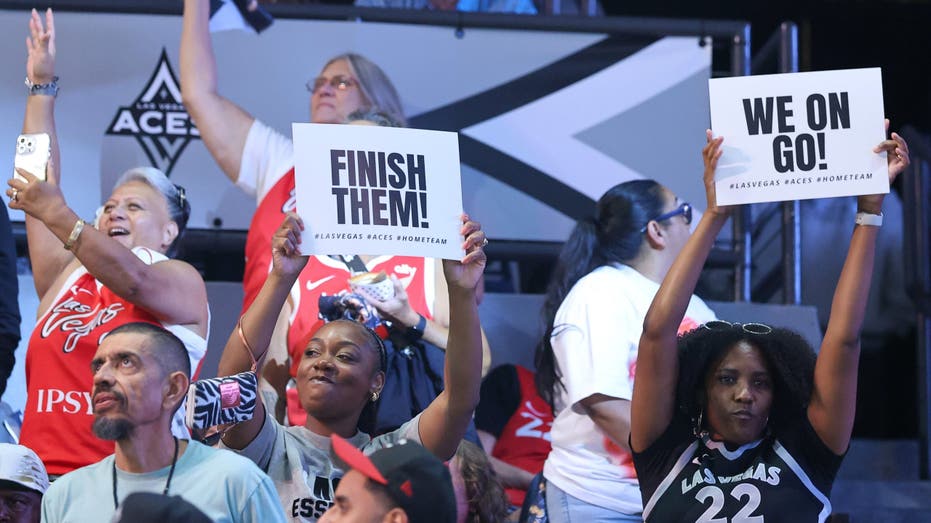
The latest flashpoint in the WNBA was not only A'ja Wilson's confrontation with a fan during Game 2 in Indiana, but also the reaction that followed. In speaking with Las Vegas Aces supporters before a later game, a familiar pattern emerged: broad accusations that Indiana Fever fans are racist, even when those making the claims could not point to verified evidence from this specific incident.
The confrontation itself has already been heavily debated. Wilson left the court area and moved more than 20 feet into the seating section to confront a fan near the baseline courtside seats after he pointed at her. The league chose not to fine, suspend, or otherwise discipline the reigning MVP. That decision raised obvious questions about player conduct, fan interaction, and whether the WNBA applies its standards consistently.
When asked about the situation, one Aces fan said the moment was about more than a single exchange. She argued it reflected larger concerns about racism and the perception that Fever fans have a racism problem. Yet when pressed directly on whether the specific fan involved was racist, she answered, "No. Not at all." She still maintained that race may have affected Wilson's reaction, citing Wilson's experience as a Black athlete and Indiana's broader history. But when asked whether there was proof that Fever fans as a group deserve that label, she acknowledged she could not say that.
That distinction matters. It is one thing to discuss racism as a real issue in society and sports. It is another to assign that accusation to an entire fan base without substantiating it. In this case, even Wilson said after the game that her response was not based on anything the fan said. The issue, by her own account, was that he pointed at her. That undercuts the immediate assumption, made by many online and in person, that a racial slur must have been involved.
Claims without proof
Another Aces fan was far more direct, repeatedly insisting that Indiana Fever fans are "racist." She said she had seen slurs yelled at games in Indianapolis and used that belief to defend the league's decision not to punish Wilson. But when asked whether a slur had actually been said in this incident, she could not confirm it. Multiple people with knowledge of the exchange, including a nearby witness, have said the fan's remark was simply, "It's on you," referring to the foul.
Even after being told that no racial language had been confirmed, the fan continued searching for another justification, suggesting the man had acted in a threatening way by stepping toward Wilson. But the larger point remained unchanged: the most serious accusation in the discussion was being repeated without verified support.
This is where the debate becomes bigger than one player or one fan. Since Caitlin Clark entered the league, claims of racism have frequently been directed at Fever supporters and Clark's broader audience. Those allegations carry serious weight, and using them loosely risks damaging both public trust and legitimate conversations about discrimination.
The WNBA has benefited enormously from its recent surge in attention. New fans have helped drive visibility, revenue, player earnings, and league-wide investment, including private travel. Many of those same fans now find themselves stereotyped in extreme terms. That approach is divisive, unfair, and ultimately counterproductive.
Racism should never be minimized, and real incidents should be addressed directly and honestly. But accusations this severe require evidence. Without it, the conversation stops being about accountability and starts becoming an attack on paying customers and fellow fans based on assumption rather than fact.
Install in seconds and keep earning from your phone.
Frequently Asked Questions
What's Your Reaction?
 Like
1
Like
1
 Dislike
0
Dislike
0
 Love
0
Love
0
 Funny
0
Funny
0
 Wow
0
Wow
0
 Sad
0
Sad
0
 Angry
0
Angry
0








Comments (0)