

States rally behind Catholic church in first-of-its-kind Supreme Court fight over prayer shrine

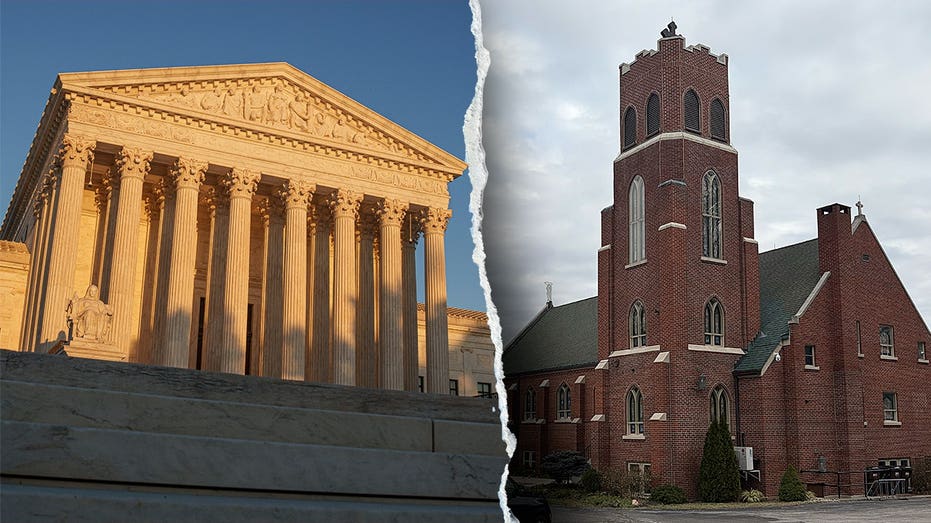
FIRST ON FOX: A Catholic religious community's plans to build a small shrine to the Virgin Mary on its own property have triggered a years-long legal battle with two neighbors, drawing a coalition of state attorneys general into a potential landmark religious liberty showdown before the U.S. Supreme Court.
Kentucky Attorney General Russell Coleman is leading an 18-state coalition urging the justices to reverse a ruling that blocked the roughly 600-square-foot prayer grotto in Park Hills, Kentucky, despite the project initially receiving approval from local zoning officials.
The dispute pits the Missionaries of St. John the Baptist against neighboring property owners Joel and Elizabeth Frederic, who challenged the city's approval of the outdoor shrine and ultimately prevailed in Kentucky's appellate courts.
YOU SHOULDN’T NEED A PERMIT TO PRAY IN YOUR OWN HOME — THE SUPREME COURT SHOULD AGREE
"I’m proud to stand with other Attorney General colleagues from across the country in defense of these Kentuckians’ religious liberty," Coleman said in a statement provided to Fox News Digital. "This fundamental American freedom cannot be brushed away simply by a heckler’s veto, and I’m confident the justices will agree."
The coalition's intervention comes as the Supreme Court prepares to consider whether blocking a religious structure on an organization's property constitutes a "substantial burden" on religious exercise under the Religious Land Use and Institutionalized Persons Act (RLUIPA).
The case marks the first time the Supreme Court is considering the federal law's land-use protections, according to Coleman's office, raising the stakes for churches and religious organizations nationwide.
The controversy began in 2021 when the Missionaries sought permission to construct a 16-by-39-foot grotto honoring the Virgin Mary's apparition to Saint Bernadette in Lourdes, France.
SUPREME COURT SHOWDOWN LOOMS OVER ST MICHAEL STATUE BLOCKED FROM PUBLIC SAFETY BUILDING
The proposed structure would include a shrine, plaza, walking path and retaining wall, offering a quiet place for prayer and meditation.
The church building has stood on the property for nearly a century, predating Park Hills' zoning ordinance adopted in 1974, according to previous Fox News Digital reporting.
The Park Hills Board of Adjustment approved the project in April 2021. But the Frederics challenged the approval in court, arguing that the proposed construction violated local zoning requirements.
A trial court initially upheld the city's decision before the Kentucky Court of Appeals reversed, finding that the zoning board exceeded its authority in granting the necessary permits.
The Kentucky Supreme Court affirmed the rejection of the Missionaries' federal religious land-use claim in December 2025.
Coleman previously defended the religious organization's position before Kentucky's highest court and led a 20-state effort in April urging the U.S. Supreme Court to take up the dispute.
The justices agreed in October to hear the case, with oral arguments scheduled for Jan. 20, 2027.
Ryan Gardner, senior counsel at First Liberty Institute, which represents the Missionaries, previously told Fox News Digital that the stakes extend far beyond the proposed Catholic shrine.
"This is a massive case for religious liberty because it has the potential to impact every single zoning law in this country," Gardner said in an October Fox News Digital exclusive.
Gardner compared the grotto's footprint to a swimming pool, underscoring the modest size of a project that has since reached the nation's highest court.
"RLUIPA is at the intersection of two very critical rights in this country: the rights of religious liberty and property rights," Gardner said.
Congress enacted RLUIPA in 2000 to protect religious institutions from certain burdens imposed through zoning and land-use regulations.
The Missionaries argue that preventing them from constructing a religious structure on their property substantially burdens their religious exercise.
The Frederics, however, have disputed that interpretation, arguing in their Supreme Court opposition brief that the religious organization failed to demonstrate why alternative locations for the grotto were unavailable.
They also challenged claims that lower courts are fundamentally divided over the legal standard for determining substantial burdens under RLUIPA.
The Supreme Court agreed to consider the substantial-burden question, rather than every issue raised in the underlying zoning dispute.
Kentucky Solicitor General Matt Kuhn, Principal Deputy Solicitor General Jack Heyburn and Deputy Solicitor General Jacob Abrahamson prepared the multistate brief, according to Coleman's office.
What began as a proposal for a quiet place to pray has become a national battle over religious liberty, property rights and how far neighbors can go in challenging religious construction on private property.

Works on Android, iPhone, Windows and Mac. No Play Store, installs in 2 seconds.
What's Your Reaction?
 Like 0
 Dislike 0
 Love 0
 Funny 0
 Wow 0
 Sad 0
 Angry 0







Comments (0)